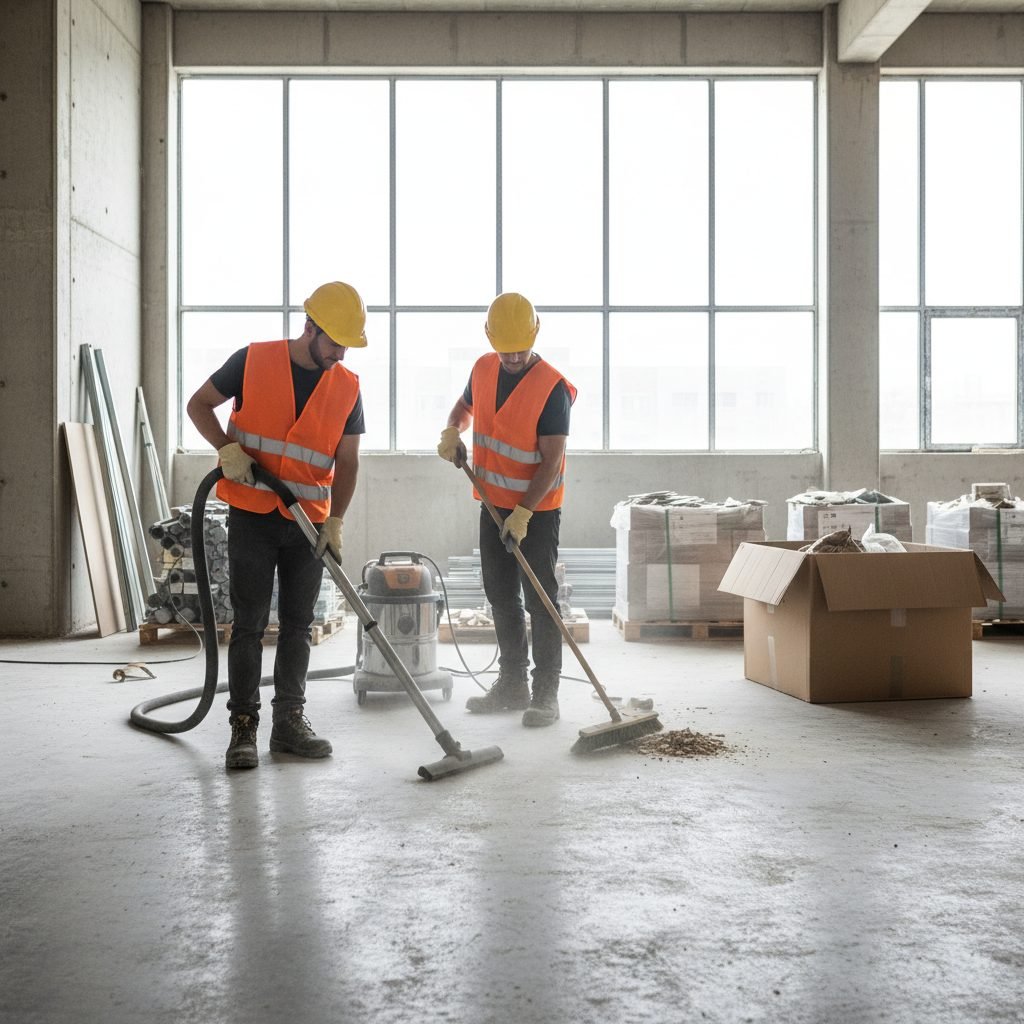
Post-construction cleaning is the job most often underestimated on a project, and the one most likely to delay a handover. The problem isn’t debris — a contractor removes that. It’s drywall dust: fine enough to stay airborne for hours, alkaline enough to damage finishes if left, and light enough to settle back onto every surface you just cleaned. That’s why a single-pass clean never works, and why “we’ll get the crew to tidy up” produces a space that still isn’t ready for a tenant walkthrough.
Serious post-construction work happens in stages, and quoting a single “final clean” for a whole project usually means one of them gets skipped.
Rough clean. After framing, drywall and major mechanical work, before finishes go in. Bulk debris, dust removal from structural surfaces, and clearing the space so trades can work cleanly. Skipping this pushes far more dust into the finish stage, where it costs more to remove and can compromise paint and flooring adhesion.
Final clean. After trades are finished. This is the substantial one: full dust removal from every horizontal and vertical surface including tops of door frames, light fixtures and ductwork exteriors; adhesive residue and paint overspray removal; sticker and label removal from windows, fixtures and appliances; protective film removal; grout haze; fixture and washroom detailing; and floors treated according to their type.
Touch-up or white-glove clean. Immediately before handover or occupancy, after settled dust has reappeared and any deficiency work is done. Usually a fraction of the final clean in cost, and the phase that determines what the client actually sees on walkthrough day.
Drywall dust is the defining technical problem in this work, and it’s why post-construction cleaning is priced differently from regular commercial cleaning.
It’s extremely fine, so it stays suspended and resettles for hours after disturbance — which is why cleaning has to work top-down and why a space cleaned in one pass looks dusty again the next morning. It’s alkaline, so left on glass, aluminium and finished surfaces it can etch or stain over time. And it travels: without containment it moves through open doorways and, critically, into the HVAC system.
That last point causes the most post-occupancy complaints. If the system ran during construction without adequate filtration, dust sits in the ductwork and gets redistributed into a freshly cleaned space for months. Vents, diffusers and returns need attention as part of the clean, and filters should be replaced at handover rather than left.
New commercial build-outs. Full sequence, all three phases, with the schedule tied to the trades’ completion dates rather than a fixed calendar.
Tenant improvements and fit-outs. Frequently in occupied buildings, which adds containment, after-hours scheduling and protection of adjacent tenanted areas to the scope.
Renovations in operating facilities. Clinics, retail units and offices that keep trading through the work. These need daily dust control during the project, not just a clean at the end — otherwise the operating side of the business absorbs the mess.
Post-renovation in medical and dental spaces. Construction dust in a clinical environment is an infection control issue, not just an aesthetic one. These run against the facility’s IPAC requirements — see dental office cleaning and healthcare cleaning.
Industrial and warehouse builds. Concrete floor cleaning and sealing at handover, high-level dust removal from racking and structure, and dock area clearing. See commercial floor cleaning for the floor side.
Booking the final clean before trades are genuinely finished is the single most costly error on a project. If painters, electricians or flooring installers return after the clean, you pay for the work twice — and the second visit is usually rushed against a handover date.
The practical approach is to book against the trades’ completion, not the handover deadline, and to hold a touch-up visit for the day before occupancy. That structure costs less overall than a single large clean repeated because the schedule slipped.
Floors deserve their own note. New floors should be cleaned and, where applicable, sealed or given their initial finish before traffic starts. A new VCT floor put into service without its initial coats will need stripping and refinishing years earlier than it should.
It’s priced per square foot but at a materially higher rate than routine cleaning, because it’s labour-intensive, requires multiple passes and often needs specialised equipment — HEPA vacuums, lifts for high-level work, and floor machines matched to new finishes.
Four things move the number: dust load and whether a rough clean happened; ceiling height and how much high-level work needs a lift; glass area, since window and frame detailing is slow work; and floor type, since new floors may need sealing or initial finish coats rather than just cleaning. Whether the building is occupied also matters — containment and after-hours scheduling add cost.
Quotes here should always follow a walkthrough. See the 2026 GTA rate report for market context on commercial rates generally.
Rough clean happens after framing and drywall, before finishes — it clears debris and bulk dust so trades can work cleanly. Final clean happens once trades are done and is the substantial phase: full dust removal, adhesive and overspray, stickers, film, grout haze, fixtures and floors. Touch-up happens right before handover to catch settled dust and any deficiency work. A quote that doesn’t distinguish them isn’t a post-construction quote.
Usually the day after the final clean if trades are genuinely finished, though a touch-up visit the morning of occupancy is worth scheduling — fine dust continues settling for a day or two after the last disturbance. If trades are still returning, moving in before the final clean means paying for it twice.
Vents, diffusers and returns are included in the scope, and we flag when filters should be replaced. Full duct cleaning, where a system ran unfiltered through heavy construction, is specialist work and we’ll say so rather than pretend a surface clean solves it — otherwise the system redistributes construction dust into your finished space for months.
Yes, as a rough clean or as staged area-by-area work. What doesn’t work is a final clean while trades are active — anything cleaned gets re-dusted, and you pay for the same work twice. If the schedule is tight, staged cleaning by zone as each area completes is the sensible structure.
It depends on the contract. General contractors typically include a basic broom-clean, which is not the same as a final clean, and tenants frequently discover the gap at walkthrough. Check what “clean” means in your construction contract before assuming it’s covered — the difference is usually rough clean versus final clean.
No. Asbestos, mould remediation and other designated substances require licensed abatement contractors, and that work has to be completed and cleared before we start. We’ll tell you plainly if something on site looks like it needs that rather than working around it.
Yes, and it’s the natural point to do it — the site brief gets written while the space is empty and everything is documented, so the ongoing programme starts with full knowledge of the building. See janitorial services or office cleaning.
Across the GTA — Toronto, Mississauga, Vaughan, Brampton, Markham, North York, Scarborough and beyond. Full list on the areas page.
Initial finish, sealing and floor programmes for new installations.
Film removal, adhesive residue and post-build glass detailing.
Ongoing building programmes once the space is occupied.
Industrial builds, concrete sealing and high-level dust removal.
Tell us the project size, phase and target handover date. Written quote with a line-by-line scope sheet back within one business day.
Or call us directly at (647) 864-5458 — Mon–Fri, 8 AM – 6 PM ET