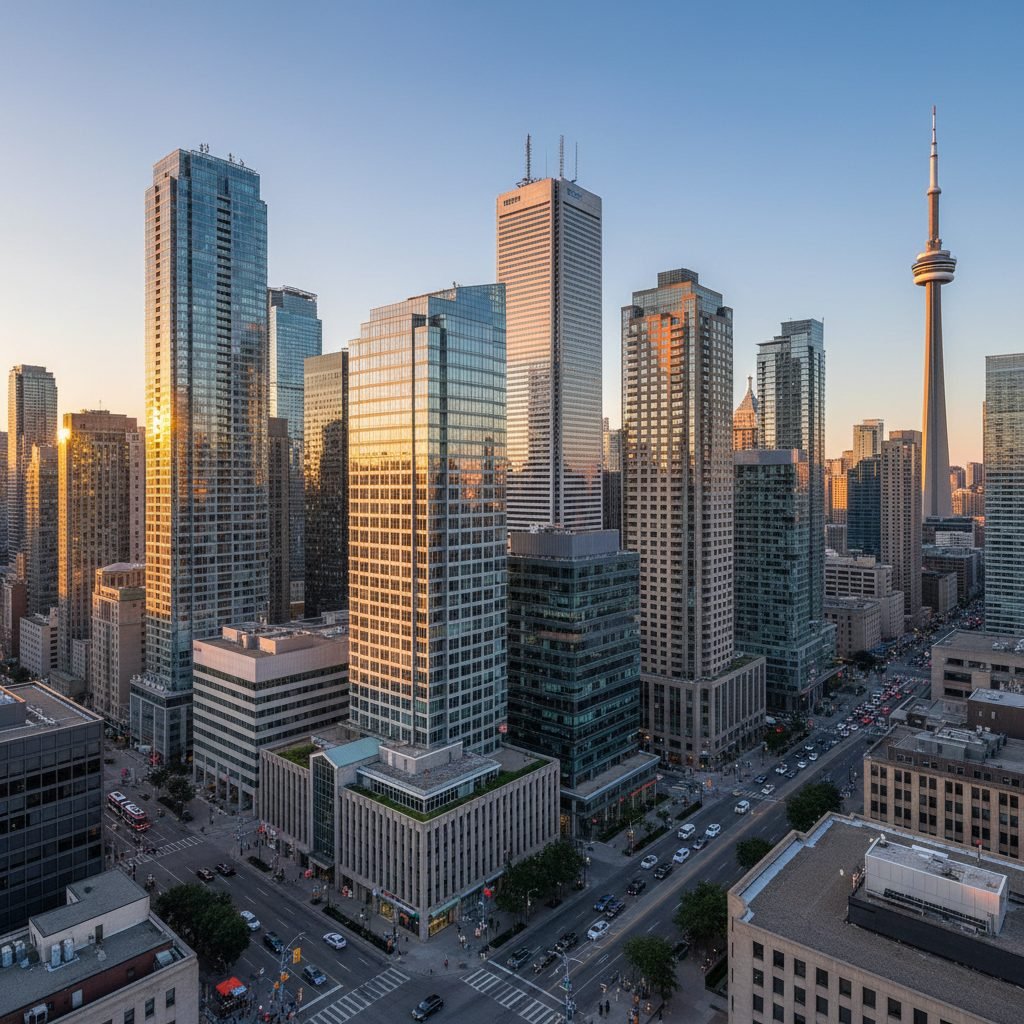
Toronto holds more commercial square footage than the rest of the GTA combined, and it’s also the hardest market in the region to clean well. Not because the work is different — because the access is. Downtown towers run booked freight elevators, security sign-in, narrow after-hours windows and building-specific insurance requirements before anyone touches a mop. A scope that works in a Mississauga flex unit falls apart on Bay Street by the second week.
Financial District and the PATH. Bay Street, King Street, Wellington, and the retail level below them. Class A towers, law firms and corporate headquarters. Two constraints govern everything here: the after-hours window your building permits, and the freight elevator you have to book to use it. PATH-level retail is tighter again — the concourse empties late and refills early, so the actual working window can be under four hours.
King West, Liberty Village and the Junction Triangle. Converted industrial space — exposed concrete, polished slab, sealed brick, open ceilings with visible ductwork. Creative agencies and technology firms with smaller footprints and much higher visual standards than their square footage suggests. Floor finishes here are rarely standard, which means the chemistry has to be identified rather than assumed.
Midtown — Yonge and Eglinton, Yonge and St. Clair, Davisville. Professional services, medical and dental clinics on upper floors, and dense mixed-use towers. Clinical space runs on IPAC-aligned protocols regardless of what the rest of the floor needs, and condo common areas fall under property management cleaning with their own board reporting expectations.
North Toronto and the Sheppard corridor. Yonge-Sheppard Centre, office parks along the subway line, government and institutional space. Larger floor plates, more predictable access, and a heavier reliance on scheduled floor programs than downtown towers need. Covered in more detail on the North York page.
East end — Leslieville, Riverdale, the Danforth. Retail strips, medical offices and restaurant rows where kitchen work has to finish before the morning prep shift starts. Early-morning scheduling is the norm rather than the exception.
Insurance naming, before access. Most Class A and many Class B buildings won’t issue after-hours access until they have a Certificate of Insurance naming the property manager or ownership entity as additional insured. That’s a document requirement with a lead time, and it belongs at the start of an engagement rather than the week service is meant to begin.
Freight elevator booking. Downtown towers allocate freight windows, and a shift that misses its slot loses the floor for the night. Any credible Toronto scope names the window and the booking procedure — not just a start time.
Green cleaning specifications. A large share of Toronto’s Class A stock is certified under BOMA BEST or LEED, and those certifications carry cleaning-product and process requirements. If your building has a green cleaning spec, the product list has to match it, and the documentation has to be available when the building asks.
Waste diversion. Toronto’s commercial waste rules mean the sorting is part of the job, not an afterthought. Buildings with poor diversion rates get pressure from ownership, and cleaning is where diversion either happens or doesn’t.
Winter, from December to March. Salt and slush track into every downtown lobby, and chloride dulls stone and finished floors fast. Entrance matting runs and an elevated winter frequency cost far less than restoring a lobby floor in April.
Most downtown buildings need a janitorial program rather than an office clean. The difference is scope: office cleaning covers desks, kitchens, washrooms and floors on rotation; a janitorial program takes on the building — waste and recycling streams and the disposal room itself, washroom servicing with consumable restocking, floor maintenance cycles, and the supply inventory behind all of it.
Downtown, three things shape that program. Waste diversion comes first: Toronto’s commercial rules mean sorting is part of the job, and buildings with poor diversion rates hear about it from ownership. Consumables come second — a Bay Street washroom on a floor of 200 people runs out of paper on a schedule you can predict, and a program that doesn’t monitor levels generates a complaint every few weeks. Floor cycles come third, and they’re the ones most constrained by the freight elevator: burnishing and restoration work needs a booked window and enough of it, which is why those cycles get scheduled quarterly against building access rather than squeezed into a nightly route.
Full detail on the janitorial services page, including how a program is scoped and onboarded.
Daily, weekly or custom. Desks, kitchens, washrooms, floors.
Full building programs. Waste, floors, supplies, common areas.
Extraction and encapsulation for high-traffic commercial carpet.
Interior and exterior. Storefronts, lobbies, office buildings.
Dust, debris and final detail after renovations or new builds.
Protocol-driven cleaning for clinics, dental offices and labs.
A downtown quote that arrives without a site walk is an average, not a price. The walk establishes the things that actually drive the number: the after-hours window, the freight booking procedure, the floor finishes on each level, the washroom count, the waste room setup and whoever holds the access authority. Those go into a site brief, and the brief becomes the document the work runs from — so a change of personnel doesn’t reset your building to zero.
For what the market currently charges, the 2026 GTA rate report breaks rates down by city and building type, and the cost calculator gives a range before anyone walks the space.
Yes. The Bay Street, King Street and PATH corridors are core to our service area. Access is coordinated with building management — after-hours windows, security sign-in and freight elevator booking are all confirmed as part of scoping rather than sorted out on the first night.
No, and it’s standard for Class A stock in Toronto. Insurance and WSIB documentation are provided before any work begins, with the building or ownership entity named as additional insured where required. It needs a few days of lead time, so it’s worth raising at quote stage rather than the week service starts.
Downtown work is coordinated through your property management for freight elevator access and loading dock times. You don’t need to arrange parking.
Yes. If your building has a green cleaning specification, the product list gets matched to it and documented in your site brief, so the paperwork is available when the building asks for it.
Yes. Five clinics across the city or three office buildings in different neighbourhoods run on one contract, one invoice and one point of contact — with a separate site brief per building, because the access rules and floor finishes differ at each one.
Typically 3–5 business days after an approved quote, though buildings requiring insurance documentation and security clearance for after-hours access can take longer. One-time cleans can often move faster.
Yes — North York, Scarborough, Mississauga, Vaughan, Brampton and Markham. Full coverage on the areas page.
Send your space details. Written quote with a line-by-line scope sheet back within one business day.
Or call us directly at (647) 864-5458 — Mon–Fri, 8 AM – 6 PM ET