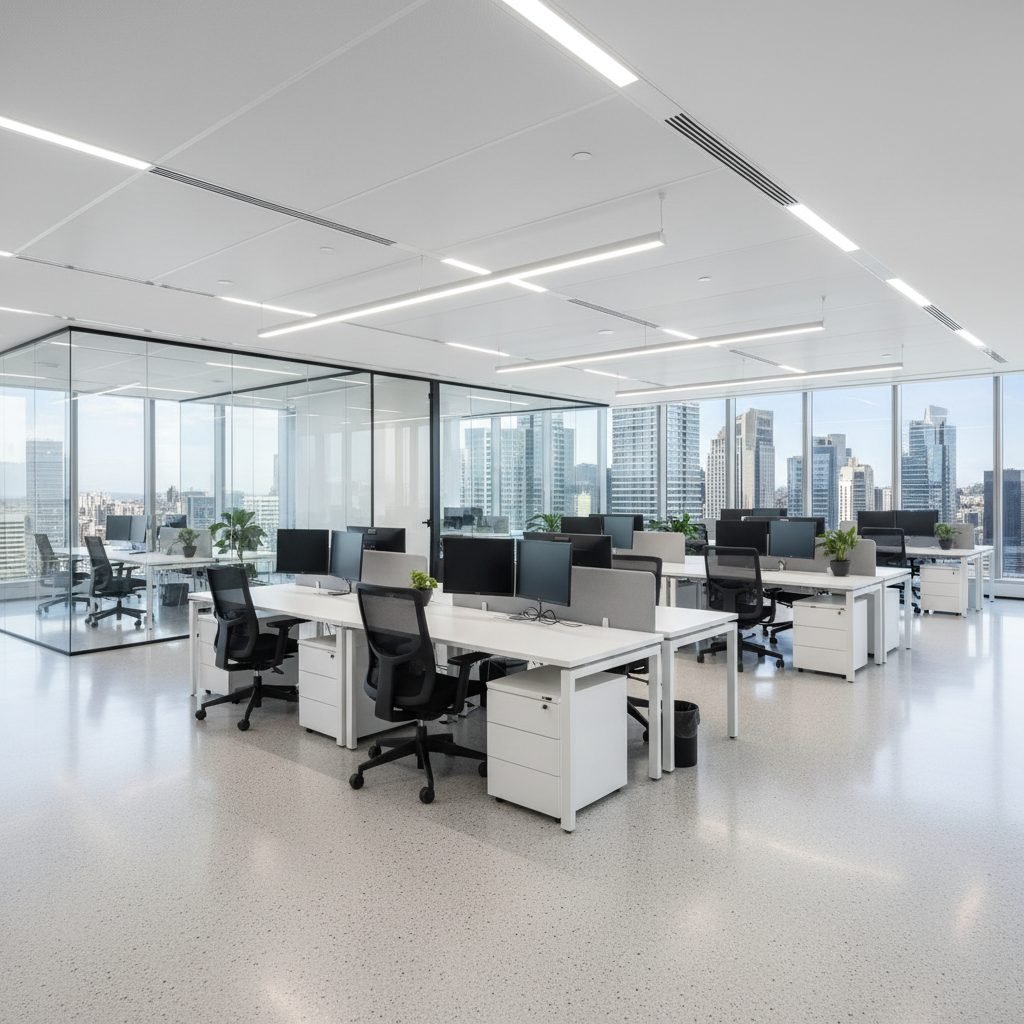
Office buildings are our bread and butter. From a 10-person law firm to a 500-seat corporate headquarters, we clean offices across Ontario — and we’ve learned that the difference between a clean office and a truly well-maintained one comes down to consistency, not effort. Anyone can deep clean a space once. Keeping it spotless on day 147 of a contract is where most cleaning companies fall apart.
If you manage an office, you’ve heard these before:
These aren’t cleaning problems. They’re management problems. We solve them with documented site briefs, scope sheets attached to every quote, and photo-verified visit logs — the operational system that catches issues before you do.
Consistent assignment. Your space gets the same people each visit. They know which boardroom has the video conferencing equipment that attracts fingerprints, which kitchen has the office snack hoarder, and which exec’s office needs the door left open after cleaning.
Quality inspections. We don’t just clean — we verify. Regular quality walks by our operations team catch issues before they become complaints. You’ll know about any problems before your staff does.
Flexibility. Need to add a deep clean before a board meeting? Skip a night because of a company event? Change frequency because you hired 30 people? One text to your point of contact. Done.
Most office cleaning companies quote from the same template and describe the same tasks, which makes them look interchangeable on paper. They aren’t. Four questions separate them, and none is about price.
Did they walk the space before quoting? A number produced over the phone is an average applied to your building. It gets revised upward once someone sees the washroom count, or the service degrades quietly to fit the price.
Will they attach a scope sheet? Task by task, frequency by frequency. Without one, “cleaning” means whatever the vendor decides on a short-staffed Tuesday, and you have nothing to point at when the boardroom isn’t done before a 9 AM meeting.
What happens when the cleaner changes? This is the question almost nobody asks and the one that predicts the next two years. In most companies the knowledge of your building lives in one person’s head — the alarm code, which kitchen is the problem one, which floor finish needs which product. When that person leaves, you start over as the explainer-in-chief. Ask what’s written down and who reads it before a shift.
Can they show you what was done? Visit logs and photos of key areas turn a monthly invoice from a claim into a record. It also changes the conversation when something is missed — from a disagreement into a documented gap.
Frequency should follow density and use, not floor area. Offices above roughly twenty people generally need daily washroom and kitchen attention regardless of square footage — those two rooms generate complaints faster than anything else in the building. Open-plan floors need more frequent vacuuming than cellular offices with the same headcount, because traffic concentrates in circulation routes.
Meeting rooms are the reputational risk. A boardroom booked for an external meeting needs to be right that morning, which is a scheduling problem rather than a cleaning one — the cleaner has to know the booking calendar exists.
Multi-tenant buildings need shared-area ownership defined in writing before service starts: corridors, shared washrooms, lobby and loading areas, each with a frequency and a named owner. It’s the single most common source of disputes between tenants and property management.
A scope sheet listing every task and its frequency, priced per square foot per visit, produced after a site walk. Anything less isn’t comparable against another quote — you’d be comparing two numbers attached to two different definitions of “clean.”
Offices over about twenty people usually need daily washroom and kitchen service, with full cleaning three to five times weekly depending on traffic. Smaller offices often run well on two or three visits a week. Frequency should be set per zone rather than building-wide — entrances and washrooms almost always need more than back-office areas.
Generally $0.025–$0.095 per square foot per visit depending on size and frequency, with the per-visit rate dropping as frequency rises. Run your numbers through the cost calculator, or see the 2026 GTA rate report.
Yes, though most offices prefer evenings between 6 and 10 PM so the work is done before the next workday. Daytime service suits buildings where after-hours access is restricted, and is usually split into a light day presence plus a fuller evening visit.
Call or text your point of contact and the affected area is re-cleaned within 24 hours at no charge. It’s logged against the building’s issue history so the same thing doesn’t recur after a personnel change.
Tell us about your office. Free quote, no obligation.