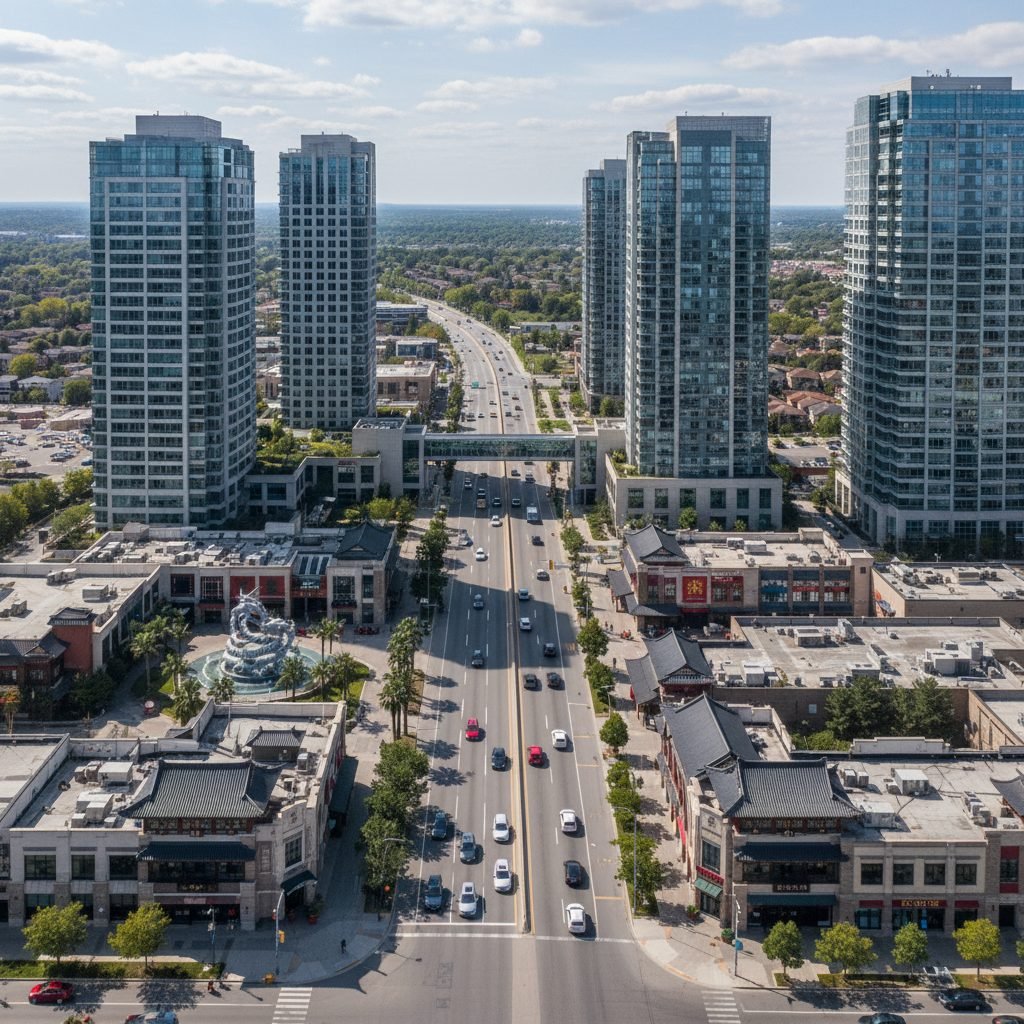
Markham is the densest concentration of technology and R&D floor space in the country outside downtown Toronto, and it cleans differently because of it. Server closets that can’t take liquids near them. Lab benches with their own protocols. Tech campuses along the 404 and 407 where the building empties at six and the alarm arms at eight. Add Milliken’s industrial belt, the retail plazas along Steeles, and the medical cluster around Cornell, and you have four separate cleaning problems inside one municipality.
Highway 404 and 407 tech corridor. Corporate offices, technology campuses and R&D facilities between Woodbine and McCowan. High presentation standards in reception and boardrooms, and a set of rooms most cleaning scopes get wrong — server rooms, network closets and lab space. We scope office cleaning for daily and weekly programs here, with equipment rooms handled as exclusions or as documented dry-only zones rather than left ambiguous.
Markham Centre and Unionville. Mixed-use towers, ground-floor retail and professional offices around Enterprise Boulevard, plus the older commercial strip through Unionville. Mixed-use is its own problem: residential waste streams, commercial waste streams and retail frontage all meet in one loading area on different schedules. Common areas here fall under condo and property management cleaning, and storefronts under retail cleaning.
Milliken and Markham Road industrial. Manufacturing, warehousing and auto parts distribution along Steeles and Kennedy. Sealed and unsealed concrete, dock aprons that collect grease through winter, and break rooms that take heavier use than any office kitchen. This is industrial floor care territory — auto-scrubbers and degreasers, not mops.
Cornell and Markham-Stouffville medical cluster. Clinics, dental practices and diagnostic offices around the hospital. These run on IPAC-aligned protocols — DIN-registered disinfectants, colour-coded microfibre, documented contact times. Dental practices have their own standard again, covered on the dental office cleaning page.
Steeles retail corridor. Pacific Mall, First Markham Place and the surrounding plazas. Food-court adjacency changes everything about a retail scope — grease migration into common areas, higher washroom frequency, and floor finishes that take a beating from tracked-in salt between December and March.
Equipment rooms need a written rule, not a judgement call. The single most common failure in tech-corridor cleaning is ambiguity about server rooms and network closets. Either they’re excluded from the scope, or they’re dry-clean-only with a named contact and an access procedure. Leaving it unstated is how a vacuum ends up somewhere it shouldn’t be.
Access is layered. Tech campuses along the 404 typically run badge access at the perimeter and a second layer at floor or lab level. That means the site brief has to record not just an alarm code but who authorises access to which zone, and what happens when that person leaves the company.
Winter salt is a floor-finish problem, not a mopping problem. Markham’s business parks are surrounded by surface parking. From December through March, chloride tracks in on every pair of boots and dulls finish fast. Entrance matting runs and a defined winter frequency in the scope sheet cost less than refinishing a lobby in April.
Tech corridor, Markham Centre, professional offices.
Multi-tenant and mixed-use buildings.
Milliken industrial, manufacturing and distribution.
Corporate carpet maintenance and extraction programs.
Yes. Offices between Woodbine and McCowan are inside our core service area. After-hours cleaning is standard here, coordinated with building access and alarm systems, and equipment rooms are written into the scope sheet as either excluded or dry-only with a named access contact.
They get their own line on the scope sheet. Standard approach is dry methods only, no liquids introduced near equipment, no vacuuming of floor voids without sign-off, and access limited to a documented procedure. If your IT or lab lead wants those rooms excluded entirely, that’s a valid answer too — it just needs writing down instead of assuming.
Yes. One contract, one invoice, with a separate site brief and scope sheet per building — because the access rules and floor finishes differ at each location even when the company doesn’t. Also covers North York and Scarborough sites.
Office space in the GTA generally runs $0.025–$0.095 per square foot per visit depending on frequency and size, with medical space higher and warehouse lower. Run your numbers through the cost calculator, or see the 2026 GTA rate report for a market breakdown.
Typically 3–5 business days from an approved quote. Markham is inside our core service area.
Send your space details. Written quote with a line-by-line scope sheet back within one business day.
Or call us directly at (647) 864-5458 — Mon–Fri, 8 AM – 6 PM ET