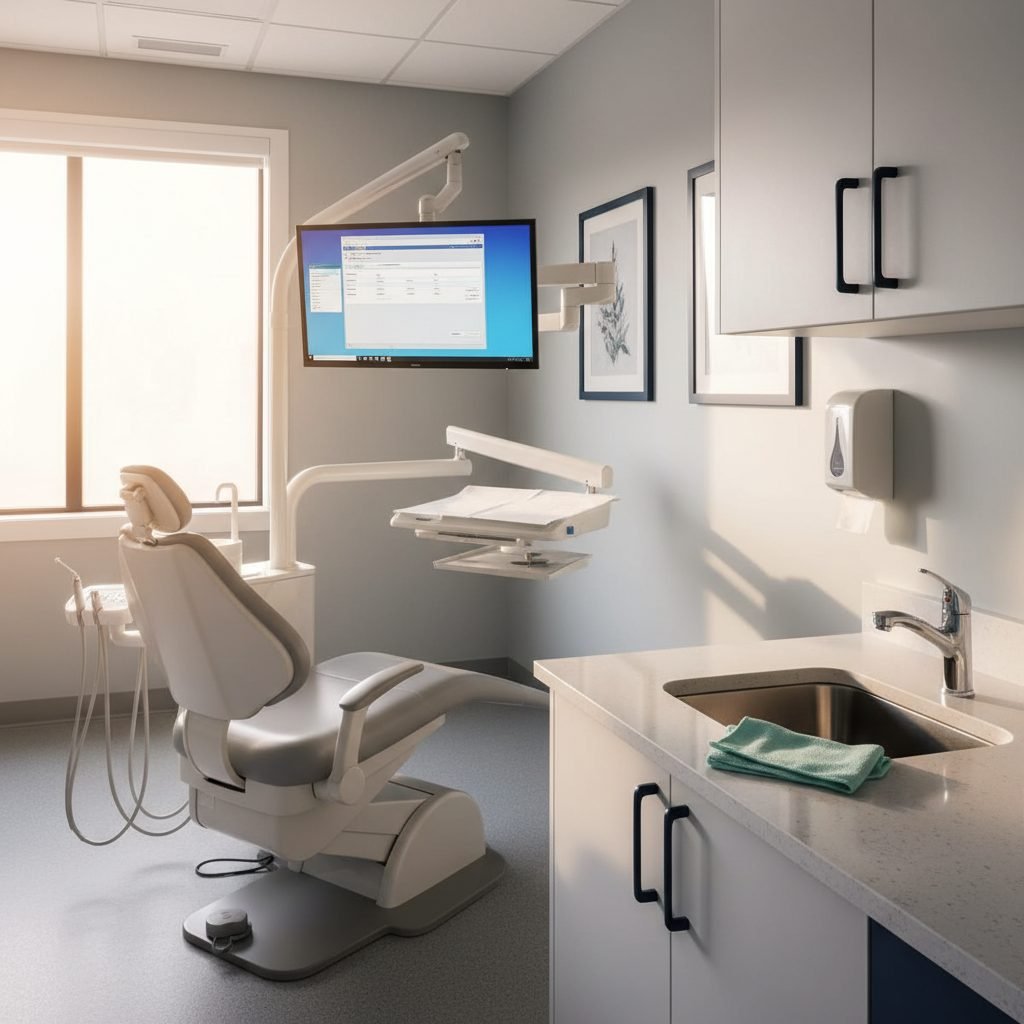
Dental practices in Ontario aren’t allowed to compromise on cleaning. The Royal College of Dental Surgeons (RCDSO) sets the IPAC standard, Public Health Ontario audits against it, and a failed inspection can pause your practice. We clean dental offices to the standard your inspector expects — DIN-registered disinfectants, colour-coded microfibre, documented contact times, full terminal cleaning at end of day. Same protocol, every visit, every crew member.
Generic commercial cleaners can clean an office. Most can’t clean a dental practice — at least not in a way that survives an RCDSO inspection. The standard is specific, and most janitorial training doesn’t cover it.
Here’s what the RCDSO and Public Health Ontario expect of any cleaning protocol in a dental practice:
DIN-registered disinfectants only. Every product used on a clinical surface must carry a Health Canada Drug Identification Number. The DIN confirms the disinfectant has been evaluated and approved as effective against bloodborne pathogens. A generic surface cleaner from a janitorial supply catalogue does not qualify. The DIN-registered hospital-grade disinfectant list for your practice is documented in your site brief, including which product is used where.
Colour-coded microfibre system. Blood-risk surfaces use one colour, clinical-but-clean surfaces use another, washrooms a third, general areas a fourth. Cross-contamination through reused cloths is one of the most-cited audit failures. A separated kit is standard — cloths are never mixed between zones, and microfibre is replaced on a fixed laundry schedule rather than visual judgement.
Documented contact times. Disinfectants need to sit on a surface for a specified time — typically 1 to 10 minutes depending on the product and the target pathogen. Wipe-and-dry-immediately defeats the chemistry. Our cleaning log records the product applied to each high-risk surface and the dwell time before wiping.
Per-patient disinfection of high-touch surfaces. Operatory chair arms, light handles, tray tables, door handles, instrument trays — wiped between every patient session. This is mostly done by clinical staff during the day, but the cleaner inherits anything missed and resets the room for the morning.
Full terminal cleaning at end of clinical day. Every exam room reset to a baseline state — surfaces cleaned, chair upholstery wiped, floors mopped with DIN-registered disinfectant, washrooms turned over, waste removed including any sharps containers staged for biohazard pickup. The morning crew shouldn’t be setting up on yesterday’s contamination.
Sharps and biohazard handling protocol. Cleaners don’t touch sharps containers but need to know where they are, what they look like, and what to do if one tips. Most generic janitors haven’t been briefed on this.
The RCDSO has begun explicitly recommending that dental practices verify their cleaning company’s IPAC training is dental-specific, not general healthcare. Our methodology page covers the documentation system we use to prove it.
Every dental practice we clean has its own brief — a documented protocol that lives with the building, not the cleaner. The protocol covers operatory-by-operatory tasks, disinfectant list with DINs, microfibre colour codes for your space, contact time targets, sharps handling, after-hours access, and any specific concerns your hygienist or dentist flagged during onboarding.
The crew reads the brief before every shift. When the crew changes — and at some point it always does — the new person reads the same brief and follows the same protocol. The standard doesn’t change because the person did.
The visit log shows you what was cleaned, when, by whom, with photo evidence of key surfaces. If an inspector asks how often the operatory floors were cleaned in the past 60 days, the answer is in your dashboard. Not in a binder somewhere, not in someone’s memory.
Most solo practices clean Monday through Saturday between the last patient and lockup, usually 8:30–10 PM. Two-person crews are typical for clinics this size — one handles the operatories and washrooms, the other handles reception, the lab, and floors. Total time on site: 90 minutes to two hours. Pricing typically lands in the $0.18–$0.25 per square foot per visit range; a 1,500 sq ft solo practice cleaned 5 nights a week runs roughly $1,400–$2,100 per month.
Three-person crews, full terminal cleaning every night, monthly deep clean of waiting areas and washrooms, quarterly upholstery clean on chairs. A 3,500 sq ft group practice with five operatories typically runs $2,400–$3,600 per month at five-night-per-week service.
Same brief format per location, consolidated reporting for the group’s office manager, single point of contact for billing. We’ve structured our process specifically so the same standard applies across locations without requiring the office manager to micro-manage each crew separately.
We serve dental practices across the Greater Toronto Area. The highest-density dental corridors we cover:
The honest test for a cleaning vendor in a dental practice isn’t whether they can clean — it’s whether they can pass an audit. Most generic janitorial crews fail in the same predictable places:
This isn’t about catching anyone out. It’s about why a $1,200/month janitorial contract for a dental practice usually costs you more in inspection risk and patient complaints than a properly-scoped $2,000/month dental-specific contract.
Alarm codes, supply layout, protocols, the receptionist’s pet peeves. Documented during onboarding. The crew reads it before every shift.
Every task, every frequency, attached to your quote. What’s on it gets done. What isn’t doesn’t get billed for.
Every visit documented with a task checklist and photos of key surfaces. You see what was cleaned, not just what was billed.
IPAC stands for Infection Prevention and Control. In Ontario dental practices, the RCDSO sets the IPAC standard and Public Health Ontario audits against it. Cleaning IPAC covers which disinfectants are used (DIN-registered only), how they’re applied (contact time documented), how cross-contamination is prevented (colour-coded microfibre), and how cleaning is documented for audit purposes.
Yes. Every product applied to a clinical surface in your practice carries a Health Canada Drug Identification Number. Our current DIN-registered hospital-grade disinfectant list is included in your site brief and available for inspector review.
Dental-specific. The RCDSO standard differs from general healthcare cleaning in a few specific ways — operatory protocols, sharps awareness, and dental-specific contact time targets. Crews assigned to dental practices are briefed on the RCDSO standard, not just a generic healthcare cleaning course.
End-of-day terminal cleaning resets every operatory to a baseline state: clinical surfaces wiped with DIN-registered disinfectant at documented contact time, operatory chair upholstery cleaned, tray tables and light handles disinfected, floors mopped, washrooms turned over, biohazard staged, sharps containers checked but not handled. The morning crew arrives to a fully reset clinic.
Most solo and small group dental practices run $0.18–$0.25 per square foot per visit. A 1,500 sq ft solo practice cleaned five nights a week typically runs $1,400–$2,100/month. Larger group practices and multi-location dental groups scale from there. Full pricing breakdown here.
Where staffing allows, yes — the same team works the same site. When the crew has to change, the new team member reads your brief before their first shift and follows the same IPAC protocol your previous crew used. The standard is documented, not held in someone’s head.
Yes. The first 30 days are a trial period with no cancellation fees and no contract penalties. If we’re not the right fit, we part ways cleanly. Your site brief and IPAC protocol document is yours to keep, regardless.
Related Guide
How much does dental office cleaning cost in Ontario? — per-square-foot and monthly pricing by practice size, what should be included, and red flags in cheap quotes.
We’ll send a written quote with the full scope and timeline so you can compare line by line.
Or call us directly at (647) 864-5458 — Mon–Fri, 8 AM – 6 PM ET