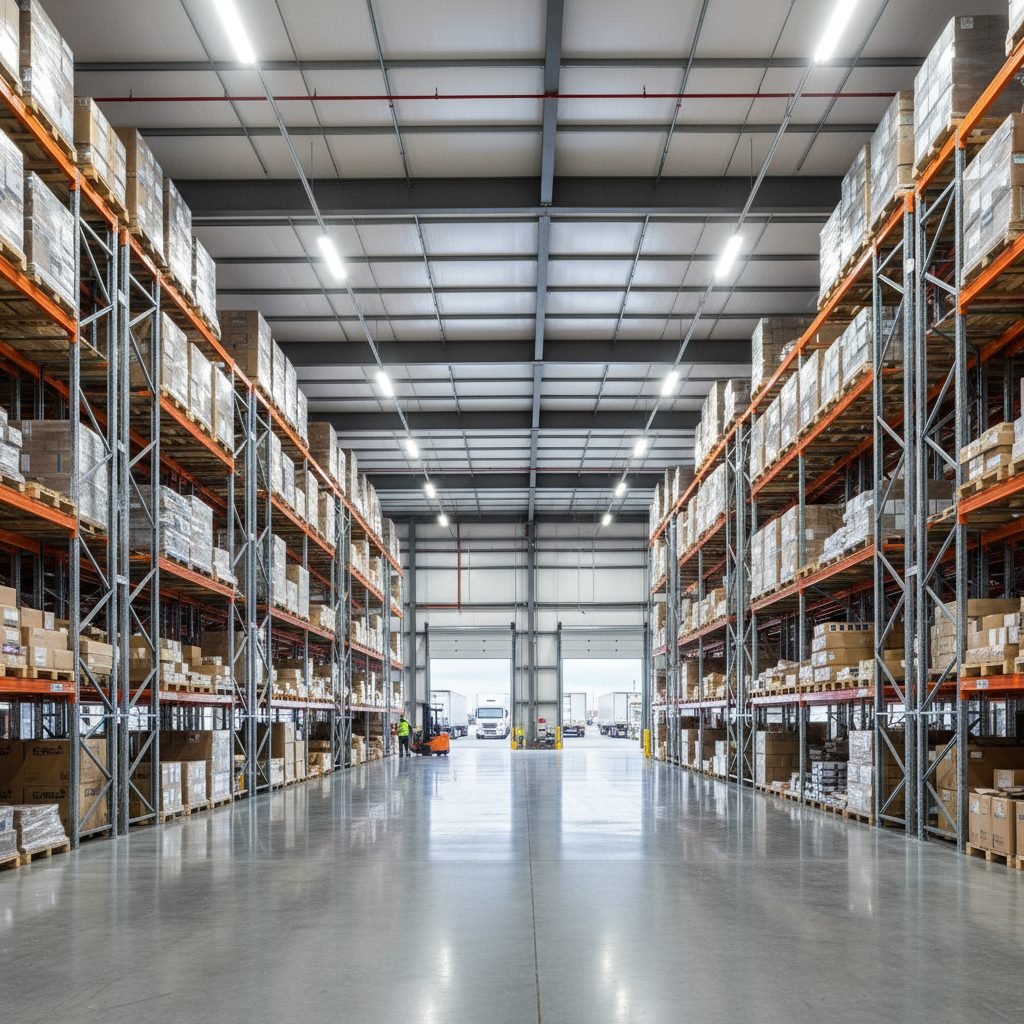
Warehouses don’t clean themselves, and office cleaning crews aren’t equipped to try. Industrial spaces need auto-scrubbers, pressure washers, and people who know how to work around forklifts and shift schedules. If your break room looks like a disaster zone and your dock floors are layered in grease, it’s time for a crew that was built for this kind of work.
The average office accumulates dust and coffee stains. Warehouses accumulate concrete dust, oil, coolant, product spills, food debris, road salt, and diesel residue — all ground into floors by forklifts and foot traffic weighing ten times what an office sees.
Standard cleaning equipment doesn’t cut it. You need industrial auto-scrubbers for the floor, pressure washers for the dock, and degreasing agents that actually work on industrial grime. Warehouse scopes are built around this equipment.
Full details on our warehouse cleaning service page, but here’s a summary:
Industrial cleaning extends well past warehouse floors. The same scope discipline applies to manufacturing plants, distribution centres, food processing facilities, cold storage and trades workshops — and each carries requirements a general commercial cleaner isn’t equipped for.
Floor programmes. Sealed and unsealed concrete behave completely differently. Sealed concrete scrubs clean; unsealed absorbs oil, hydraulic fluid and tyre polymer permanently. Where a floor is unsealed and taking damage, sealing is the real answer rather than more frequent cleaning.
High-level and racking dust. Dust accumulating on racking, beams, sprinkler pipework and light fixtures is a fire-load and sprinkler-performance issue, and in food or pharmaceutical facilities an audit finding. It needs lifts, containment below and a shutdown window — scoped as a periodic project, usually annual or semi-annual.
Dock aprons and levellers. Grease, road salt and standing water make these the most common slip-hazard location in the building. Degreasing on a defined cycle, heavier through winter.
Break rooms and washrooms. These take far heavier use than any office equivalent because they serve concentrated shift populations in short windows. Frequency should follow shift patterns, not office norms.
The defining constraint in industrial work is that the building rarely empties. A facility running two or three shifts has no natural cleaning window, so the scope has to name which zones clear and when, and accept that some work happens alongside active operations.
That makes safety scoping part of the quote rather than an afterthought: forklift traffic patterns, which aisles can actually be closed and when, lockout requirements, and whether high-level work needs a production pause. A quote that hasn’t addressed those hasn’t accounted for how the work will really happen — and usually gets revised once it meets the floor.
Concrete floor programmes with auto-scrubbers and appropriate degreasers, high-level dust removal from racking and structure, dock apron and leveller degreasing, break room and washroom servicing on shift-based frequencies, and waste area management. Office areas within the same building are scoped and priced separately because they need different equipment and frequency.
Zone by zone, yes. Areas that never clear get serviced alongside operations at a defined frequency with the safety requirements written in; areas that clear get the standard treatment. High-level work generally needs a shutdown or weekend window.
Yes, executed against your facility’s own food safety programme — the approved chemicals it specifies, the documentation your auditor expects, and the zoning it requires. We execute the cleaning side of that programme; we don’t write or certify it.
Traffic-dependent. High-throughput distribution floors often need weekly machine scrubbing; lower-traffic storage areas may run monthly. The more useful question is whether the floor is sealed — an unsealed floor degrades regardless of frequency, and sealing changes the economics permanently.
Warehouse and industrial space generally prices below office space per square foot, because the cleanable detail per square foot is lower — though floor programmes, high-level work and sealing are quoted separately as projects. See the 2026 GTA rate report for market context.
Tell us your square footage and what you need. We’ll build a plan around your shifts.